
Neoprene Fabric: Technical Properties, Performance and Sustainable Innovations

Neoprene fabric features a 3-layer construction: neoprene rubber/sponge core sandwiched between laminated face fabrics, bonded with water-based adhesive. Both the core rubber and face laminates are customizable.
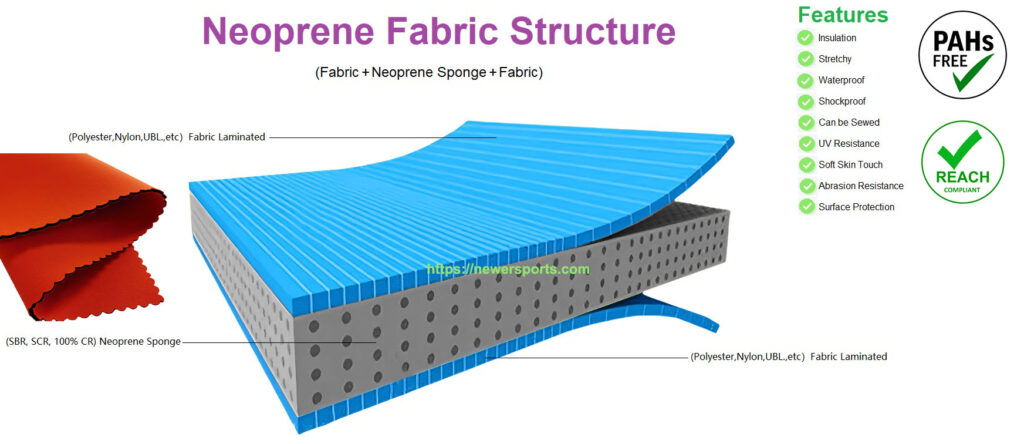
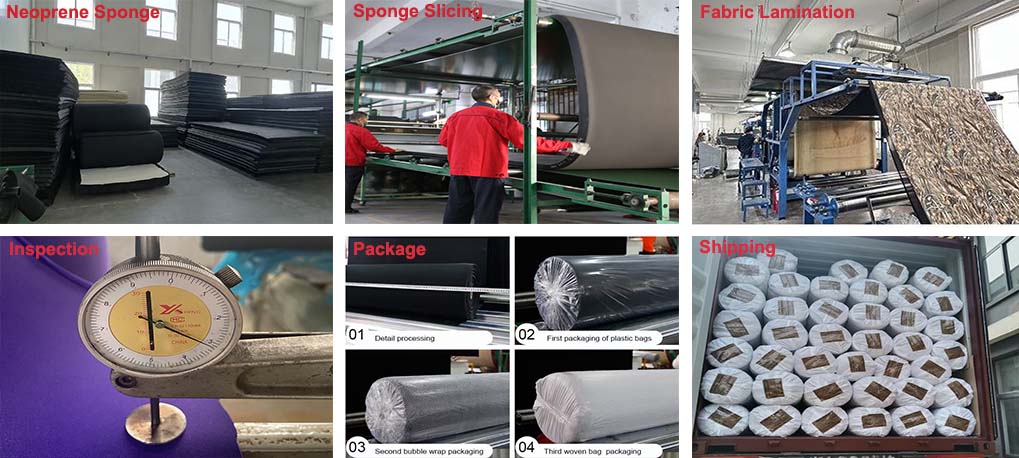
neoprene fabric structure

How Is Neoprene Fabric Produced?

neoprene fabric manufacturing process

Polymerization: Creating the Rubber Base

The first major step is polymerization. Here, the chloroprene monomer undergoes a chemical reaction to form long chains of polychloroprene. Think of it like tiny individual beads linking together to form a long string. This process can be done in different ways (like emulsion polymerization or solution polymerization), each yielding slightly different properties in the final rubber. The result at this stage is a raw, solid rubber known as polychloroprene chips or crumbs.

Foaming and Shaping: The Core of Neoprene's Properties

This is where the magic happens and neoprene gets its signature characteristics.

1.Compounding: Adding the Special Ingredients

The raw polychloroprene chips are mixed with various additives in a process called compounding. These additives are crucial as they determine the final properties of the neoprene fabric:

  • Vulcanizing Agents: These chemicals (like sulfur or peroxides) are essential for curing the rubber, giving it elasticity and durability.

  • Fillers: Materials like carbon black or silica can be added to enhance strength, hardness, or processability.

  • Foaming Agents: These are vital! When heated, they release gas, creating the closed-cell structure that gives neoprene its insulation and buoyancy.

  • Accelerators, Activators, and Stabilizers: These control the reaction rates and protect the material from degradation over time.

  • Pigments: For colored neoprene fabric, pigments are added at this stage.

2.Curing and Foaming: The Formation of Neoprene Sheets

The compounded rubber mixture is then fed into a large, heated press. Under high pressure and temperature, two key things happen simultaneously:

  1. Curing (Vulcanization): The rubber cross-links, forming a stable, elastic network.

  2. Foaming: The foaming agents decompose, releasing gas that expands within the rubber, creating tiny, isolated gas bubbles. This is what forms the characteristic closed-cell foam structure of neoprene.

The result is a large, thick block or “bun” of foamed neoprene rubber.

Finishing Touches: Slicing and Laminating

The large neoprene bun isn’t immediately usable as fabric. It needs further processing.

1.Slicing: Achieving the Desired Thickness

The huge neoprene bun is carefully cooled, then fed into a specialized slicing machine (often called a “skiver”). This machine precisely cuts the block into thin sheets of various thicknesses, ranging from less than 1mm to several millimeters, depending on the application. This is where you get to specify the thickness for your custom neoprene fabric!

2.Lamination: Adding Fabric and Functionality

Finally, the sliced neoprene sheets are ready for lamination. This is the process where fabric layers are bonded to one or both sides of the neoprene sheet using strong adhesives and heat. Common fabric laminates include:

  • Nylon Fabric: Offers good stretch, durability, and a smooth finish.
  • Polyester Fabric: Known for its strength, colorfastness, and resistance to wrinkles.
  • OK Neoprene Fabric: This refers to a standard, high-quality neoprene, often laminated with a fabric like nylon or polyester on one or both sides. It’s prized for its excellent insulation properties, water resistance, cushioning, and flexibility. It’s widely used in wetsuits, laptop sleeves, orthopedic braces, and protective gear.
  • Embossed Neoprene FabricThis type of neoprene has a textured pattern pressed into its surface.The embossing can enhance grip, improve flexibility in specific areas, and add a decorative element.
  • Lycra/Spandex: Adds extra flexibility and a snug fit.
  • Terry Fabric: Provides a softer feel and often used for medical supports.

The choice of fabric significantly impacts the final feel, appearance, and performance of the neoprene fabric. This step also allows for various surface treatments like smooth skin, embossed textures, or perforated patterns.

Quality Control: Ensuring Excellence

Throughout every stage of this process, stringent quality control measures are in place. This includes testing the raw materials, monitoring temperatures and pressures during foaming, checking the thickness of sliced sheets, and verifying the adhesion and quality of the laminated fabrics. This ensures that the final neoprene fabric meets industry standards and your specific requirements.

Performance Characteristics

Is Neoprene Waterproof?

The answer depends on structure and treatment. Closed-cell neoprene creates a water-resistant barrier through millions of sealed air pockets – water physically cannot penetrate without considerable pressure. However, seams and stitches compromise this barrier. Medical and industrial grades solve this through:
  • Electron-beam bonded seams
  • Ultrasonic welding
  • Liquid neoprene seam taping
Professional drysuits using 7mm calendered neoprene with welded seams maintain waterproof integrity at 200m depths.

Is Neoprene Breathable?

Neoprene’s breathability paradox stems from design intent:
  • Closed-cell variants prioritize thermal retention with MVTR (Moisture Vapor Transmission Rate) below 500g/m²/24h
  • Open-cell neoprene achieves MVTR exceeding 3000g/m²/24h – comparable to technical textiles
  • Modern hybrids like nano-perforated neoprene maintain water resistance while offering targeted airflow
Sports apparel increasingly uses laser-perforated panels to manage microclimate ventilation without sacrificing insulation.

Stretch Capabilities

Neoprene outperforms natural rubber with elongation rates up to 800%:
  • Entry-level: 100-150% elongation
  • Sports-grade: 250-400% multidirectional stretch
  • Advanced: 500%+ in specialized flex-zones
Athletic applications exploit engineered anisotropic stretch – maximizing mobility in joint areas while maintaining compression elsewhere.

Performance Advantages and Limitations

Critical Advantage: Chemical/UV Resistance

Where most materials fail, neoprene thrives:
  • Withstands ozone concentrations up to 200ppm
  • Resists oils, acids, and alkalis maintaining integrity after 168-hour immersion tests per ASTM D471
  • Achieves UV resistance up to 1,000 hours under ASTM G154 without embrittlement
Chemical plants increasingly specify neoprene gaskets after incidents where rubber seals deteriorated within weeks of chemical exposure.

Key Limitation: Thermal Regulation Tradeoffs

The same insulation capacity that protects divers in frigid waters becomes problematic in warm environments:
  • Core temperature increases ≈0.8°C/hour in 20°C air (versus 0.3°C/hour in technical mesh)
  • Maximum operating temperature is ≈120°C continuous (thermal degradation begins at 150°C)
  • Cold flexibility threshold is ≈-50°C
Advanced solutions include:
  • Phase-change material (PCM) linings absorbing excess heat
  • Graphene-enhanced composites improving thermal conductivity
  • Variable-thickness mapping in apparel designs

Fire Resistance & Safety Compliance

Beyond moisture protection, neoprene fabric serves critical safety functions:
  • Achieves UL94 HB fire rating with flame spread <76mm/min
  • FMVSS302 automotive certification for flame resistance <4 inches/minute
  • Meets aviation standard AS5127/1 for non-flammability in aircraft
  • Complies with ROHS, REACH SVHC, and Oeko-Tex® Class I for skin contact
Notably, chloroprene’s chlorine content provides inherent fire resistance surpassing hydrocarbon rubbers. Manufacturers enhance this with:
  • Antimony trioxide flame retardants
  • Aluminum trihydrate fillers
  • Ceramic microsphere impregnation

Real-World Applications: Industrial and Consumer Use Cases

Industrial Domains

  • Aerospace: Anti-vibration engine mounts, cabin pressure seals
  • Automotive: EV battery isolators, fuel-resistant hoses
  • Energy: Subsea cable insulation, oil rig gaskets
  • Medical: MRI-safe components, prosthetic liners
  • Robotics: Gripper pad skins, industrial armoring

Commercial Innovations

  • Sports Tech: Impact-reducing padding in contact sports
  • Consumer Electronics: Multi-layer vibration isolation in HDD systems
  • Architecture: 30-year seismic joint fillers in skyscrapers
  • Agriculture: UV-stabilized crop protection sleeves

Sustainability Focus: Eco-Friendly Innovations

The industry confronts neoprene’s petroleum legacy head-on with groundbreaking alternatives:
  1. Bioprene™: 70% Hevea milk blended with synthetic polymers
  2. Limestone-based neoprene: Eliminates petroleum use while matching performance metrics
  3. Yulex®: Plant-based formula achieving 90% CO₂ reduction vs. conventional
  4. Recycled Programs:
    • Econoprene™: 50%+ recycled content from industrial scrap
    • End-of-life recycling yielding fibers for concrete reinforcement
  5. Water-based production: Replacing solvents reducing VOC emissions by 90%
LCA studies show modern sustainable neoprene production reduces climate change impact by 40-60% compared to 1990s processes.

Durability in Outdoor Environments

When tested under ASTM D1149 marine standards, premium neoprene fabric demonstrates:
  • 5,000-hour salt fog resistance without cracking
  • 85% tensile strength retention after UV exposure equivalent to 3 Arizona summers
  • 200,000+ flex cycles in jointed applications
Outdoor gear manufacturers exploit this durability through:
  • Dynamic Reinforcement: Kevlar® ripstop in high-abrasion zones
  • Self-Healing Surfaces: Micro-encapsulated chloroprene filling minor abrasions
  • Anti-Biofouling Treatments: Preventing marine growth on aquaculture gear
This engineered endurance explains why satellite manufacturers qualify neoprene components for 15-year orbital missions.
The future of neoprene is heading toward smarter, more environmentally friendly designs. Researchers are working on exciting new versions:
  • Temperature-responsive neoprene that adjusts its thickness in heat/cold
  • “Smart” neoprene that can sense wear and tear
  • Eco-neoprene that stays strong during use but breaks down naturally afterward
From ocean exploration gear to robot components, this versatile material keeps finding new uses – showing how innovation can work hand-in-hand with protecting our planet.